
So much infrastructure starts far from the people it serves, in country nobody ever built a communications network for.
So many things that matter start where people aren’t.
The power line most worth watching runs down a canyon with no houses nearby. Fifty miles out of town, there’s extreme weather. A pipeline pressure anomaly occurs in a remote area where crews need a passable road. Pump stations, reclosers, tank batteries, wind turbines, and critical gauges all sit at the far end of the same logic: infrastructure is purposely built far from people to minimize cost and reduce environmental impacts. It can make sense, yet also add risk during disruptions and emergencies.
By the time downstream effects are experienced in town, an event could have been underway for a while. Every hour an operator gains is an hour recovered from the event’s head start, and every one of those minutes is won or lost a long way from town.
Which is part of why utilities and other critical infrastructure industries have dramatically increased the number of sensors deployed across their infrastructure. Sometimes, the places most worth watching turned out to be the places that didn’t have any network coverage.
Nobody Builds a Tower for a Canyon
Commercial network footprints follow people. A tower must be justified by the number of customers who will pay to use it, so coverage is thick where population is dense and thin to nothing across remote areas where infrastructure faces additional risks. Terrain like canyons, hills, and rivers compound the challenge in areas that are toughest to cover with modern connectivity.
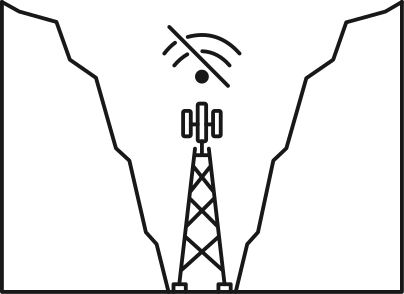

Then there is the hour itself. Public networks carry their heaviest traffic during the events that matter most, when everyone in a region reaches for a phone at the same moment. The night an operator most needs critical sensor data is the night a shared network has the least spare capacity. Coverage that thins where the population thins, and strains when the weather turns, is not coverage anyone can run critical operations on with confidence.
A Network with One Customer
Private wireless turns the economics around. Rather than accept the coverage a carrier found worth building, an operator can design coverage around its own infrastructure, and a site is justified by the asset it protects instead of the subscribers it serves. Towers go where the risk is. Signal is engineered to reach into the places equipment actually sits. Because the network belongs to the operator, nothing else is competing for room on it when the event arrives, and the equipment is theirs to inspect, repair, and expand on their own schedule, which counts for most in the days after something has gone wrong and crews are already out restoring safe operations.
What comes out of it is a network with one customer, built for one system, carrying data from thousands of devices that would otherwise sit dark.
What an Hour is Worth
An hour turns a fault into a work order instead of an outage. It buys enough margin to act ahead of the weather, and it helps inform whether a line should be de-energized ahead of a wind event. An hour is also a crew already rolling when the call comes in, with the right part already on the truck.
None of that is visible to the people it protects. Warning works that way, and the network that produced the hour never gets any credit for it. The people downstream and down the line will never think about wireless spectrum, and they should not have to. What they will notice, if it ever comes to that, is that somebody knew in time.
That knowledge came from a device standing somewhere nobody lives, on a network somebody decided to build out there on purpose.